
What GLP-1s Do to Your Bones: The Hidden Trade-Off of Rapid Weight Loss That Your Doctor Isn't Warning You About
New research suggests that when the weight comes off too quickly, your bones can quietly come off with it — especially in women over 40. Here's what a Doctor of Physical Therapy says every woman in this situation should know before another month goes by.
If you've lost a significant amount of weight in the past year — or you're in the middle of losing it now — this may be the most important article you read this season. The weight is coming off. But what's coming off with it could leave you frailer, weaker, and looking older than your years.
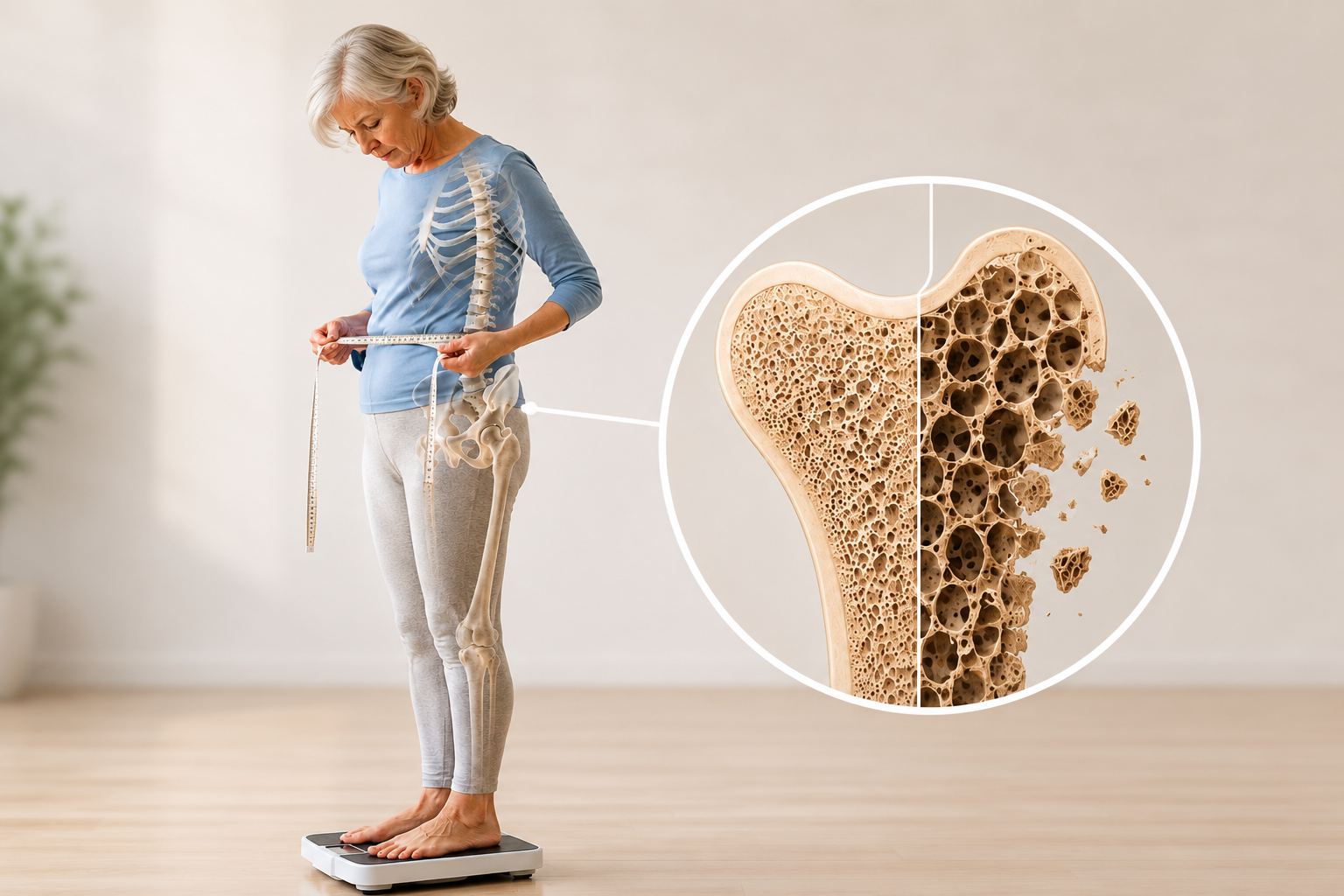
When my sister Linda lost 32 pounds in four months last spring, she was thrilled.
The weight came off fast. Her cravings settled down. Her blood sugar dropped. For the first time in 15 years, she could shop in the "regular" section at the department store.
Then, in August, she slipped on a wet patio step.
She didn't fall hard. She didn't fall from any height. She just… slipped.
She fractured her wrist in two places.
Her doctor ordered a DEXA scan — a bone density test. The results stunned both of them.
In the eight months since the weight started coming off, my 52-year-old sister had the bone density of a woman a decade older than her.
And she wasn't the only one.
The Bone Loss Trade-Off Almost No One Warns You About
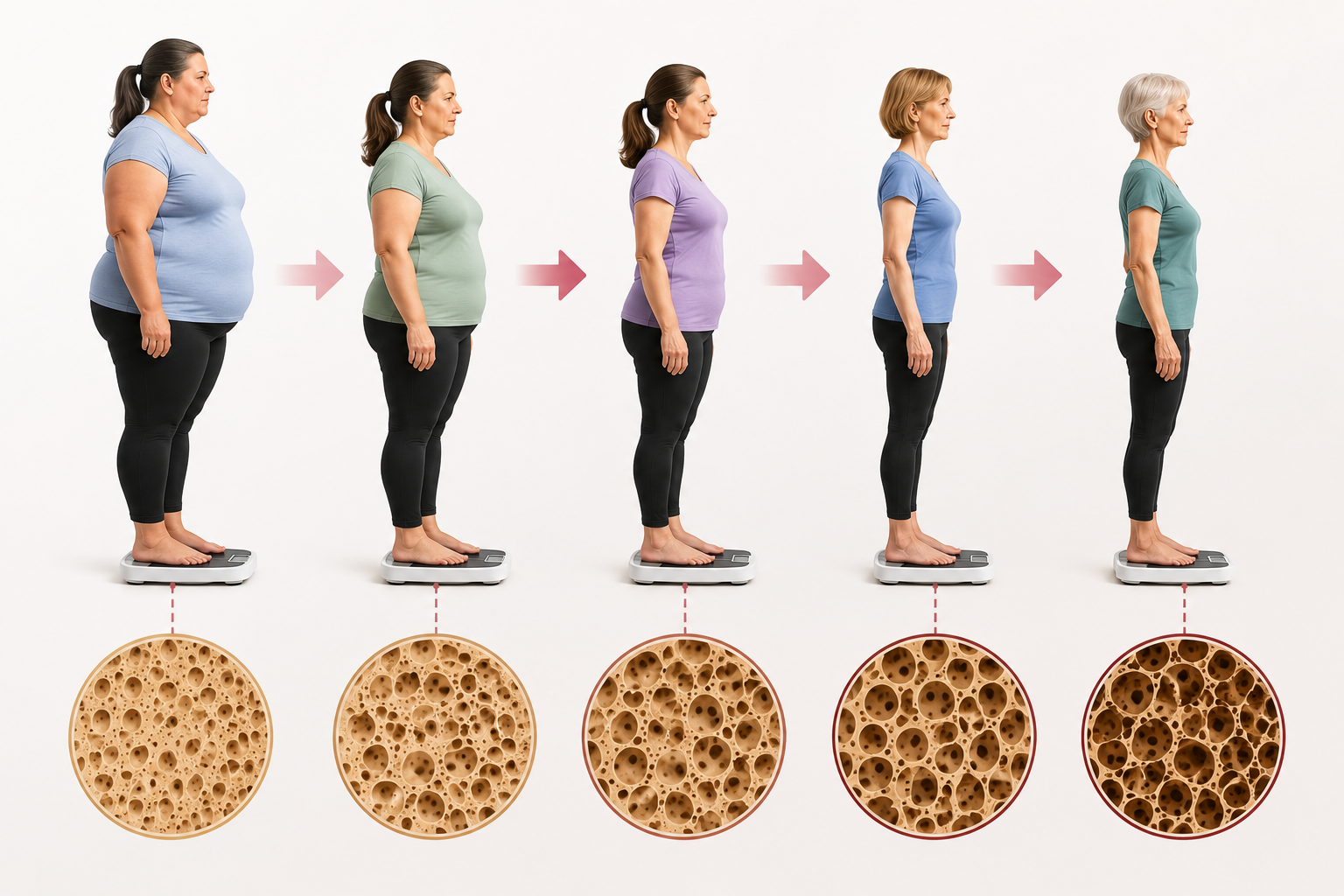
We're living through the biggest wave of fast weight loss this country has ever seen.
Some of it is happening through diet. Some through surgery. Some through newer medical options women are talking to their doctors about. And for millions of women, the results have been life-changing — better blood sugar, easier mobility, more energy.
But there's a trade-off the conversation rarely covers. A trade-off that doesn't make it into the before-and-after photos. A trade-off that's increasingly being recognized in women who lose weight quickly:
Research published in journals like Metabolism have suggested that women losing weight rapidly may experience bone density changes at notably faster rates than women losing weight gradually through diet and exercise alone.
Separate analyses out of the University of Alberta have suggested that as much as 40% of the weight lost during rapid weight loss may come from lean tissue — meaning muscle, bone, and collagen-based connective tissue — not fat.
Let that sit for a moment.
Nearly half of what's coming off may not be the weight you wanted to lose.
It may be the structural foundation of your body.
Why Rapid Weight Loss Can Leave the Body Short on Collagen
While I was researching this online, I found a video of Dr. Chad Walding, a Doctor of Physical Therapy and co-founder of NativePath, explaining what was actually happening underneath the scale.
His explanation was sobering.
"When women dramatically cut their calories — for any reason — they're often cutting protein with it. And protein, specifically the amino acids that build collagen, is what your body uses to maintain bone, muscle, skin, and connective tissue. If the raw materials stop coming in, the body starts drawing down what it already has."
In other words: rapid weight loss isn't only burning fat. It can also leave the body short on the building blocks it needs to maintain its own structure.
"The weight loss is often a wonderful thing. But what's happening underneath, structurally, is real too. Most women have no idea until they fall, fracture something, or look in the mirror and don't recognize the gaunt, hollow person looking back."
That hollow look is the visible part many women are starting to notice — the sudden deflated, drawn appearance that can accompany quick weight loss after just a few months.
But the visible part is the smallest part. The harder-to-see changes are the ones worth paying attention to:
- Lower bone density
- Reduced muscle mass and grip strength
- Thinner-looking, less elastic skin
- Hair shedding and weaker nails
- Joint discomfort as the body adjusts
- Less structural resilience overall
What Most Doctors Haven't Connected Yet
Here's what makes this so frustrating: there's a clear, well-researched way to help support the body through it.
But it isn't on most doctors' radar yet.
That help is high-quality collagen peptide supplementation, paired with adequate protein at every meal.
Multiple peer-reviewed studies have suggested that supplementing with hydrolyzed collagen peptides during periods of rapid weight loss may help:
- Support bone mineral density (one 2018 study in postmenopausal women showed meaningful improvements in bone density measurements after a year of consistent collagen peptide supplementation)
- Support lean muscle mass during caloric restriction
- Support skin elasticity — which can soften the drawn, hollow look that often accompanies fast weight loss
- Support joint comfort as the body adjusts to a new weight
- Support hair, nail, and connective tissue strength
In other words: collagen may be one of the most important things a woman can add to her routine during significant weight loss.
And yet, I haven't heard of a single primary care office that routinely recommends collagen during weight loss.
"Why Hasn't Anyone Told Me This?"
This was the question that had been on my mind since Linda's scan.
Dr. Walding's perspective was simple.
"Doctors are trained to manage the medical side — the labs, the blood pressure, the blood sugar, the cholesterol. They're not always trained in nutritional support during weight loss. So a woman comes in for her follow-up, the doctor checks the numbers, and nobody is asking the bigger question: 'What are you doing to protect your bones, your muscles, and your skin while this is happening?'"
The result? Millions of women are doing the right thing for their weight — and quietly losing more than they bargained for at the same time.
What to Look For in a Collagen (Most Are Junk)
Here's where this gets complicated. If you walk into any grocery store, drugstore, or warehouse club, you'll see dozens of collagen products on the shelf.
Most of them aren't worth your money.
After looking into the collagen industry, here's what actually matters:
1. Grass-Fed, Pasture-Raised Source
Cheap collagen comes from feedlot cattle raised on grain, hormones, and antibiotics. The collagen extracted is biochemically inferior. Look for grass-fed, pasture-raised.
2. Type 1 and Type 3 Peptides
These are the two collagen types the body uses most for bones, skin, hair, nails, and connective tissue. If a label doesn't specify, it usually means they're using whatever's cheapest.
3. Proper Hydrolyzation
The peptides need to be broken down to a specific molecular weight — small enough for the body to absorb intact. Cheap brands skip this step because it's expensive.
4. Clean Label
Pure collagen peptides should be the only ingredient. No sweeteners, no flavors, no gums, no fillers. It should also be third-party tested to ensure it's free from harmful levels of heavy metals.
5. Adequate Dose
Most clinical research showing benefits to bone and muscle used 10–20 grams of collagen peptides per day. A lot of products give you 5g and call it a serving.
Why I Started Recommending NativePath to Every Woman I Know Going Through This
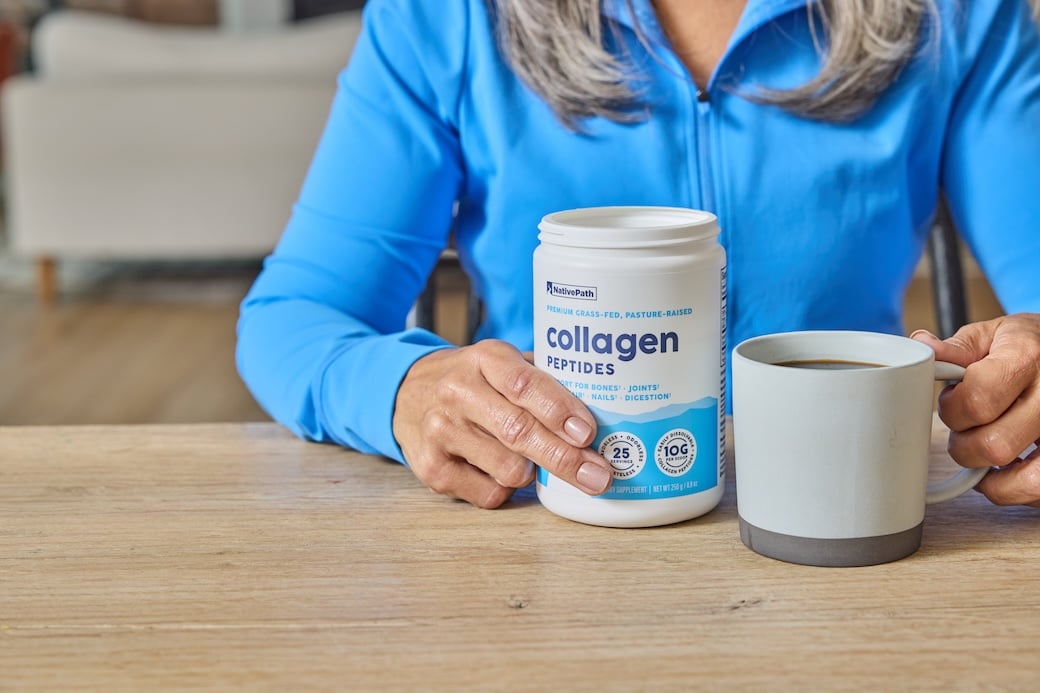
After comparing 14 collagen brands side by side, only one passed all five criteria: NativePath Grass-Fed Collagen.
NativePath is sourced from grass-fed, pasture-raised cattle in Brazil (one of the strictest cattle standards in the world). It contains both Type 1 and Type 3 peptides. It's hydrolyzed to an optimal molecular weight.
The ingredient list is one line long: collagen peptides. And each scoop delivers a clinical 10g dose.
It dissolves instantly in hot or cold liquid — no taste, no clumping. You can put a scoop in your morning coffee, your tea, even a glass of water, and never know it was there.
For my sister Linda — who's still keeping the weight off — it's become non-negotiable. Her doctor ran a follow-up DEXA scan six months after she started NativePath. Her bone density numbers had moved in the right direction. Her hair stopped shedding. Her skin looked less drawn.
She's still keeping the weight off. But she's no longer losing herself.
What to Do If You're Losing Weight Quickly
If you're in the middle of significant, rapid weight loss — for any reason — here's what I'd recommend based on everything I've learned:
- Get a baseline DEXA scan. Know where your bone density is today, so you can track changes over time.
- Prioritize protein at every meal. Aim for around 30g per meal, even when your appetite is small.
- Add a high-quality collagen peptide daily. This may be one of the most important things you can do for your body during this season.
- Do resistance training at least twice a week. Lifting signals the body to preserve bone and muscle.
- Don't wait. The structural changes happen quietly. By the time the drawn look shows up in the mirror, plenty has already changed underneath.
A Special Offer for Women in This Season
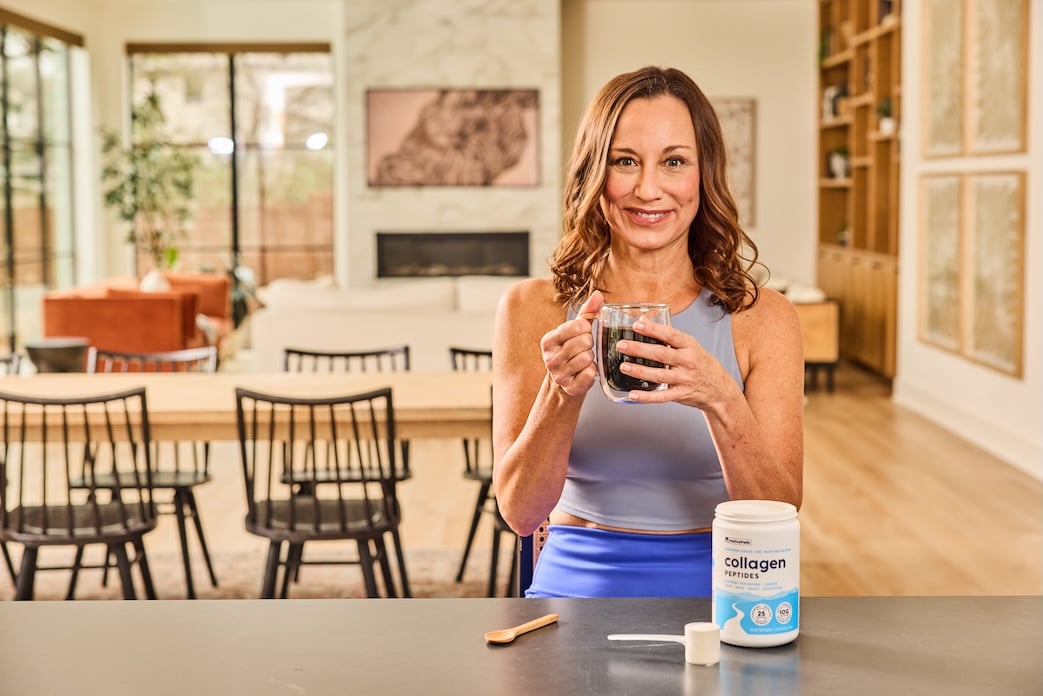
Right now, NativePath is offering 45% off for first-time customers, plus free shipping on every order.
If you're in the middle of significant weight loss — or you're about to begin — I wouldn't wait on this. Every week without adequate collagen support is another week your body may be drawing on reserves it shouldn't have to.
I'd recommend starting with at least a 90-day supply, since that's the minimum window most women need to start feeling the difference.
To your health,
Rachel T.
Health Correspondent
Customer results have not been independently verified. Individual results may vary. This article depicts an experience consistent with real customer feedback.
These statements have not been evaluated by the Food and Drug Administration. This product is not intended to diagnose, treat, cure, or prevent any disease. Always speak with your healthcare provider before starting any new supplement, especially if you have a medical condition or are taking prescription medication.